Showing posts with label 2009. Show all posts

Friday, December 25, 2015

The Dehydrator Bible

The Dehydrator Bible
Authors: Jennifer MacKenzie, Jay Nutt, Don Mercer
Publisher:  Robert Rose (2009)

The art of preserving food has always been crucial to the livelihood of humans around the globe. Ancient peoples savoured (often accidentally) fermented vegetables, fruit in honey, salted or smoked meats and dried perishables of all kinds, eventually documenting and refining their processes so that future generations could continue eating year-round, regardless of the season. With the invention of modern refrigeration, flash freezing, vaccuum-sealing and untrapasteurization (not to mention worldwide import/export trade) making essentially every food accessible any time, the "old fashioned" methods of "putting by" at home are slowly, but surely, becoming extinct. Before home preserving practices completely dry up, I strongly suggest taking a look at some of the dedicated manuals out there and trying your hand at the craft yourself. The Dehydrator Bible by Jennifer MacKenzie, Jay Nutt, and Don Mercer sets out to encompass everything you could ever want to know about this method of homesteading, from times and temperatures to dealing with the question of what to do with it all at the end.
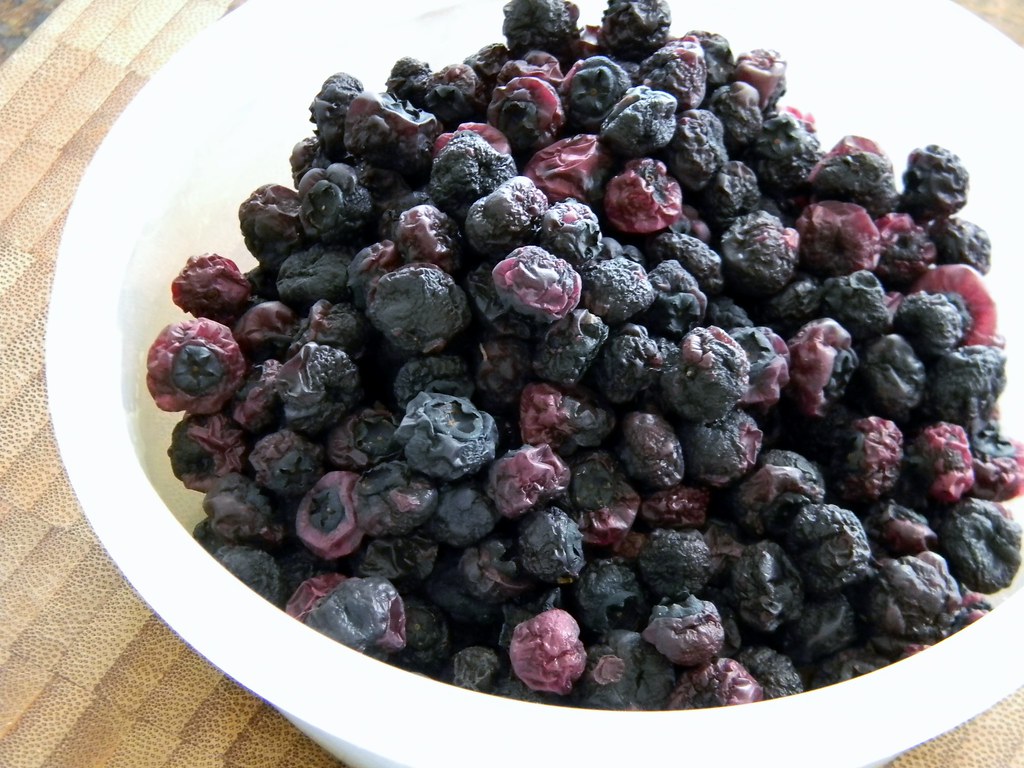
Dried Blueberries
Dried Wild Blueberries

One of the easiest and cheapest ways to make food shelf stable indefinitely (or at least longer) is dehydrating. Removing the water from foods reduces the likelihood of spoilage greatly and allows for higher volume per gram ratios - a boon for backpackers or bikers - and saves freezer and fridge space for fresh, local foods. Dehydrating preserves nutrients and (in most cases) flavours, and allows even the most casual homesteader to have a "just in case" section of their pantry primed for unexpected guests or financial stress. All these benefits can cost as little as $40 for a serviceable dehydrator, and for the truly obsessed more upscale models can be purchased for upwards of  $200.
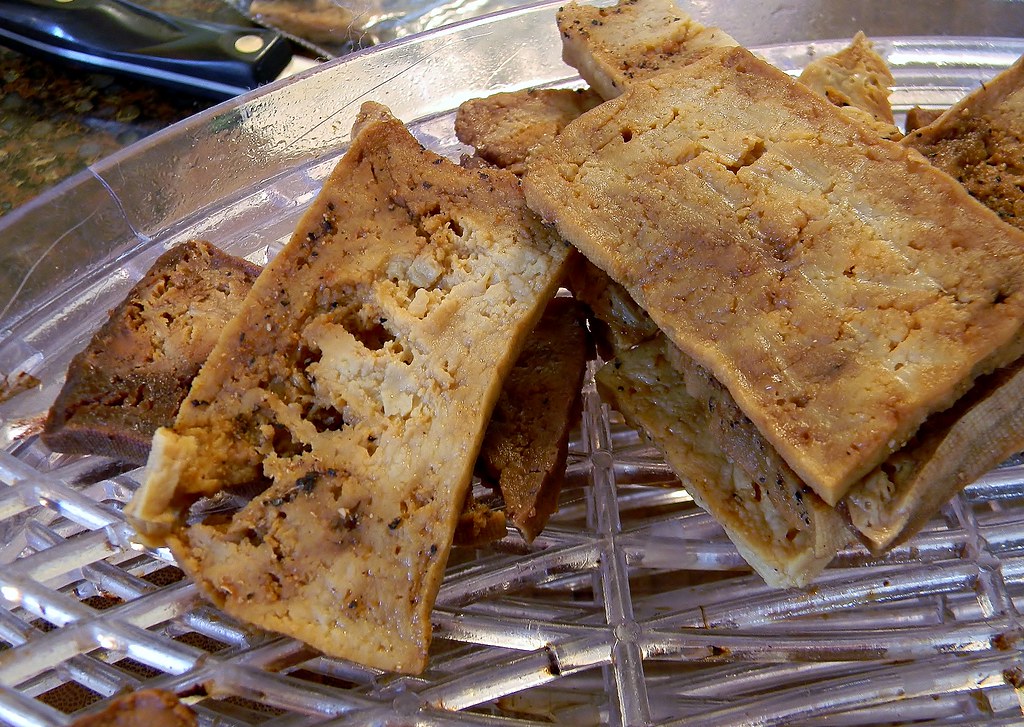
Teriyaki Tofu Jerky
Tofu "Jerky"

This book is filled with lots of ways to not only dry your own foods at home safely, but ways to use them too. Some of the recipe are a bit hit-and-miss texture wise (like Teriyaki Orange Simmered Beef (p.122)) especially if you are used to eating 100% fresh. However, other recipes like Pear, Raisin and Walnut Chutney (p. 160) and Mushroom, Garlic and Rosemary Soup (p. 96) seem to be made for the technique. Desserts, snacks and quickbreads abound as well, and are a great first choice for those learning to cook with dried food. Black Forest Cookies (p. 203) and Secret-Ingredient Fudgy Brownies (p. 208) are on my to do list for sure!

If you're looking to try a new way of looking at food and cooking, why not try a new method? The Dehydrator Bible will open your eyes to a delicious, nutritious world - and I'm sure you'll be hooked too.
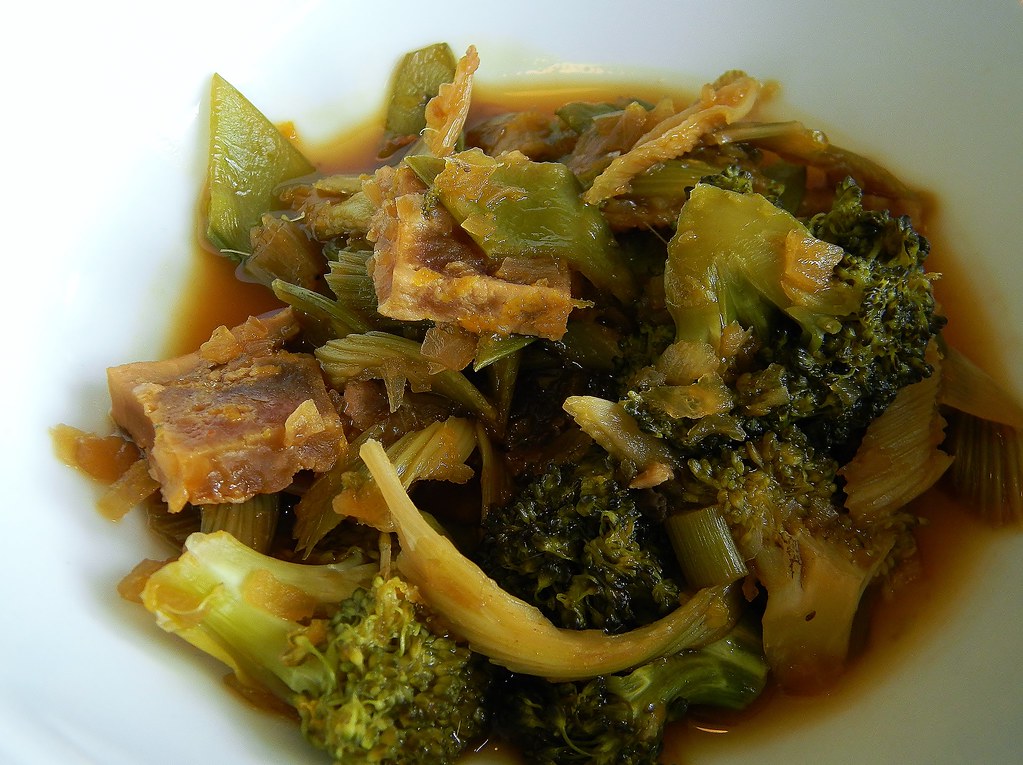
Saucy Simmered Teriyaki Tofu Bowl
Teriyaki Orange Simmered Tofu (p. 122)

From the Back Flap:

This 50,000-copies-sold bestseller on food dehydration has been updated!

Whether you grow your own food, buy it locally from farmer’s markets or farmstands or even buy it from a regular supermarket, seasonality still affects its price and abundance. Therefore, it makes sense to preserve food for those times when it’s not as plentiful, or not available at all. Drying food is a wonderfully tasty and easy way to do this.

All of the wonderful original recipes are still here. What has changed is that the “Dehydrating Foods” section has been expanded to include even more comprehensive and complete information about dehydrating foods, along with even more tips and techniques.

The book includes more than 150 recipes for dehydrating herbs and seasonings, fruits, vegetables, meats and fish, and more than 250 delicious recipes that actually use the dehydrated foods as ingredients so you can put home-preserved food to work for you in your home, RV, boat or campsite.

The easy-to-follow drying instructions and time guidelines will make even a novice cook feel like a seasoned professional in no time. So plant a few extra rows of tomatoes or beans, pick a heap of strawberries at their peak or buy that big basket of freshly harvested carrots. Then load up your dehydrator. You’ll be thrilled to be cooking with your own dried foods the whole year through!

Available on Amazon

Tuesday, September 11, 2012

The Locavore Way: Discover And Enjoy The Pleasures Of Locally Grown Food


The Locavore Way: Discover And Enjoy The Pleasures Of Locally Grown Food
Author: Amy Cotler
Publisher: Storey Publishing (2009)
 
Eating local is all the rage these days. From tiny roadside stands with Bristol-board signage proclaiming backyard strawberries to five star restaurants building entire tasting menus from local suppliers and reality television challenges, it's the latest trend in food culture for good reason. Local food is picked riper and shipped less, allowing the best nutrition and (most importantly) the truest flavours of the fruit or vegetable to shine. While you would figure that the task of eating what is produced around you is an easy one, it's not always the case. Labelling is hit and miss, some farmers markets are actually selling imported goods and occasionally the prices are higher thanks to the lack of corporate mass-farming operations keeping costs to a minimum. Amy Cotler attempts to ease the transition to a more locally based diet in her book The Locavore Way: Discover And Enjoy The Pleasures Of Locally Grown Food.

Locavore Way is if nothing else a valiant attempt to humanize the still somewhat elitist world of farm-to-table living. With a personable writing style and many helpful lists and subsections including stories from producers who follow the "local food first" philosophy, Cotler addresses many key concerns such as sourcing local food, finding farmers markets and restaurants who provide truly auto-produced or regional fare, how to shop and prepare what you buy or grow for the best results and most importantly - doing all of this on a budget. While similar books become akin to sermons or lectures on how conventional eating is the root of all evil, and usually promote a strict vegetarian way of life, Locavore Way is less so. A certain amount of preaching is present however, especially where the chapter Connect and Engage (p. 180) and the appendix section Key Events in Local Food History (p. 216) are concerned, but in general the message Cotler brings is full of passion and backed with experience, whether her own or her interviewees.

Unfortunately, due to the fact that anything to do with local eating is by nature only applicable to the immediate surroundings, some of this book specific points and examples lack relevance for anyone outside of Cotler's location of northeastern America. Many of the points mentioned in Locavore Way are, while important in their own right, also dependent on living in cities within the United States with easy access to services like Community Supported Agriculture (p. 47), bulk Buying Clubs (p. 67) and well stocked supermarkets and specialty grocers, not to mention longer growing seasons and better climates than those in Canada or the United Kingdom can hope to have. This book also struggles with a lack of fresh, revealing content for it's target audience. In essence, the messages shared in anyone outside of Cotler's location of northeastern America. Many of the points mentioned in Locavore Way are intuitive, and the majority of consumers already understand the basics of why and how to eat locally that make up this book's skeleton. A lot of the information in this book is identical across chapters and sections, simply re-stating the same facts in different language, occasionally sounding like the author simply turned to a Thesaurus and re-wrote what came up. A section that would have been appreciated is a section of tips for finding a "better option" when, as in the case of us up north, local options are out of season or too expensive. A portion of the book I looked forward to, "The Seasonal Eater" (p. 18), is unfortunately impractical for the majority of readers, since today people tend to thrive on variety, not to mention an array of foods in the diet is important for overall health. Even her well-intended section "10 Reasons to Eat Locally Produced Food" (p. 10) is written from an idealistic perspective - for instance, point #3 (For the health and safety of your family and yourself) is not necessarily the case - just because a vegetable or loaf of bread came from next door doesn't mean it isn't laden with chemicals, pesticides and preservatives, less processed or more sound nutritionally than a similar item. Number 6 (For an open, working landscape) would be wonderful if it was as common as Cotler may have you believe, but the truth remains that local production does not equal historical or pristine landscapes and environments.

I appreciated the fact that Cotler took the time to connect with like minded farmers and document their stories, particularly those of Breezy Hill Orchard and Stone Ridge Orchard (p. 35) which were a great eye opener as to the challenges of biodynamic farming. Her section on "Local vs. Organic" (p. 13) was refreshing to read as well, as it reiterated what many shoppers are unaware of in terms of the costs of certification preventing many local farms from applying the label regardless of their identical practices. Her farmer's market planning guide (p. 23) is fantastic, especially for those who have never ventured to one. "15 Ways to Become a Locavore" (p. 4), while imperfect in it's ability to be applied carte-blanche across livelihoods and locales, is a good start for complete local neophytes and worth a read even if you've eaten local for years. While the section dedicated to seasonal eating was more flash and less substance, readers can find lists of what to look for (at least in the northeastern US) by season in the sections titled "The Seasonal Market" (p. 33) and a sample CSA "share" listing from Sproutwood Farms (p. 64). As a foodie, the chapter Play with your Produce (p. 146) was a wonderful resource for preparation and serving ideas (whether using local or supermarket fruits and vegetables), and as it covers some of the less familiar items like celeriac, jicama, fennel, kohlrabi, Jerusalem artichokes and tomatillos the information may entice even the wariest cook to look at it in a different way. For budding gardeners, Locavore Way also has a fairly basic starter guide to growing your own, but I would suggest true beginners consult a gardening manual before jumping in head first.

For those just discovering the local way of eating, The Locavore Way: Discover And Enjoy The Pleasures Of Locally Grown Food is a good first read to test the waters with. Amy Cotler takes care to inform, inspire and impassion even the most skeptical consumer, and provides enough solid, basic material that readers can move on and apply specific principles to their lives in the way that suits their lifestyles best. A perfectly 100-mile existence is out of reach for many, but regional and in-season eating is attainable at least some of the year. When it's as close as your backyard, there's no reason not to try a taste of local living.

Available on Amazon

Thursday, August 18, 2011

The Baking Answer Book: Solutions to Every Problem You'll Ever Face; Answers to Every Question You'll Ever Ask

The Baking Answer Book: Solutions to Every Problem You'll Ever Face; Answers to Every Question You'll Ever Ask
Author: Lauren Chattman
Publisher: Storey Publishing, LLC (2009)

Some of us grew up in the kitchen clamouring to stir cookie dough and knead bread with nary a box mix in sight, especially if Mom, Dad or Grandma was around to guide the process. While mixes and pre-made foods clearly still have a consumer following, the trend now is to eliminate the excess processing and additives that go into those items and return to the call of scratch baking. So what then of the ones who grow up without an intuitively baking parent – or who were too busy racing around as children that the kitchen didn’t hold that same allure? Scratch baking is not out of reach for the average kitchen elf thanks to the wealth of comprehensive baking guides on bookstore shelves. Arguably one of the most concise and well organized of these resources is Lauren Chattman’s work The Baking Answer Book: Solutions to Every Problem You'll Ever Face; Answers to Every Question You'll Ever Ask.

In Baking Answer Book, readers will find 350 pages of common questions and their detailed, practical answers in an easy to read, no-frills format. Chattman includes only the information that the common baker would find useful in day-to-day applications, and her information spans an array of topics from Ingredients (p. 1) and Equipment (p. 38) to complex Layered Pastry (p. 277) and the often-problematic Yeast Breads (p. 308). The author also includes recent additions to the baker’s kitchen by addressing questions on non-stick, insulated and silicone bakeware (p. 43-46). Chattman also incorporates applications of her answers, with simple and reliable recipes for classics such as Low-Fat Wheat-Bran Muffins (p. 136), Oatmeal Chocolate Chip Cookies (p. 162), New York Cheesecake (p. 220) and the quintessential No-Knead Bread (p. 332). By no accounts, however, is Baking Answer Book a recipe manual. The goal is to inform and ease the creation of the modern cook’s own recipes, not build their cookbook repertoire from ground zero.

This book is one that all bakers, aspiring and experienced, will find useful. Chattman’s tips on freezing batters (like muffins (p. 133) – an application I had never thought of) and doughs (breads are “risky” (p. 337) while cookie dough is better than baked in this respect (p. 191-193)). While I don’t need her help on the subject of pastry bags and tips or cake-frosting techniques (p. 231-238), having taken classes at George Brown College and making up my own solutions for many issues, I did love the author’s glossary of the varieties of cake (p. 201), and her charts of pan volumes (p. 47), as well as metric equivalents (p. 356) as a reference. Having also made many a pie by my mother’s side, much of the help Chattman offers on this subject (p. 240-276) was wasted on me. However, Chattman includes the invaluable conversions of whole to crumbled cookies for crusts (p. 271) and a handy storage guide for the baked pies (p. 274-275). Detailed resource lists for any and all things baking related, including Chattman’s most valued cookbooks, fill the final pages of this book. Those living at high altitudes will be delighted to know that Baking Answer Book includes a special appendix of these answers as well (p. 351).

The only minor issue I do take with Chattman’s piece is in her discussion of specialty flours. While those who out of necessity keep gluten-free diets will already know their “can” and “can’t” grains and flours, others may not realize that soy flour is completely gluten-free (not “substantially lower” as the author notes (p. 12)) as is buckwheat (lumped into a list of specialty flours but whose status is ignored while the other grains have mention (p. 13)). Again, this is a minor oversight but is one of the reasons why information from a variety of sources is always preferable on a subject such as this.

I thoroughly enjoyed The Baking Answer Book: Solutions to Every Problem You'll Ever Face; Answers to Every Question You'll Ever Ask by Lauren Chattman – it is truly an incredible resource and has both piqued my interest in the “whys” of baking, and answered many questions I have asked over the years. I look forward to sharing the knowledge with those bakers around me and applying it to my own kitchen experiences.

Available on Amazon